ASP.NET & AI Integration for Health & Fitness Client in USA
Facile Technolab improved a fitness app with .NET backend fixes, TensorFlow AI integration, and admin panel enhancements for on-time release.
Read Full Case Study
Build AI-powered features into your existing applications or develop new AI-enabled products. Facile Technolab provides custom artificial intelligence development services, combining LLM integration, machine learning, workflow automation, and Microsoft .NET and Azure engineering.



Your AI project should solve a business problem, not become another proof of concept that never reaches production.
Many businesses know where AI could help, but connecting it to existing software, business data, and everyday workflows is where implementation gets difficult. Facile Technolab combines AI development with enterprise software engineering to bridge that gap.
Our experience building .NET applications, SaaS products, APIs, and Azure-based solutions helps us develop AI features that fit into the systems your teams already depend on.
For a US health and fitness application, our team worked on .NET backend improvements, TensorFlow AI integration, and administration features as part of the product's development.
Explore Our Software Development Case StudiesDiscuss your application, business problem, and potential AI use cases with our team.
Add AI capabilities to your .NET applications, APIs, and Azure infrastructure without automatically replacing your current systems.
Identify specific opportunities for document processing, predictive insights, workflow automation, and intelligent application features.
Start with a defined use case, validate feasibility, and expand implementation based on results and feedback.
Combine AI services and models with ASP.NET Core, Azure, enterprise databases, and existing business integrations.
AI has the most impact when it is integrated into the software your teams already use. Facile Technolab designs and builds AI features on top of custom .NET and Azure applications, helping operations-heavy businesses automate routine tasks, surface insights, and support better decisions.
We work with mid-sized organizations that already rely on Microsoft technologies and want to add AI in a practical, incremental way. Typical engagements include adding AI features to existing products, building new AI-enabled modules, and modernizing legacy workflows with intelligent automation.
AI for production: demand forecasting, quality anomaly detection, and predictive insights embedded into your .NET and Azure manufacturing systems.
Learn more →AI for care workflows: triage support, document extraction, reminders, and analytics integrated into ASP.NET Core and Azure healthcare applications.
Learn more →AI for fintech & insurance: risk scoring, fraud alerts, and customer insights built into your custom Microsoft .NET and Azure financial platforms.
Learn more →AI for event platforms: recommendations, pricing and attendance predictions, and automated communications in your .NET-based event SaaS.
Learn more →From AI strategy and machine learning to LLM integration and workflow automation, we develop AI capabilities that work within your existing business applications. Our team combines AI engineering with .NET and Azure expertise to help you move from experimentation to practical implementation.
Identify where artificial intelligence can solve real business problems. We assess your workflows, existing applications, and data readiness to create a practical AI implementation roadmap.
Add predictive capabilities to your software to support demand forecasting, risk assessment, anomaly detection, and data-driven decisions using machine learning models.
Integrate AI assistants into customer portals, SaaS platforms, and internal applications to answer questions, retrieve information, and support routine interactions.
Use customer behavior and business data to support relevant product recommendations, personalized experiences, and targeted content within your applications.
Develop image and document analysis capabilities for use cases such as visual inspection, document capture, object recognition, and automated information extraction.
Prepare business data for AI applications through cleaning, transformation, integration, and structuring. Establish reliable inputs for analytics and machine learning solutions.
Design and integrate machine learning models for classification, prediction, scoring, and recommendations based on your business requirements and available data.
Connect large language models, Azure AI services, and custom AI components with your .NET APIs, databases, and applications. Support document Q & A, RAG, summarization, and content analysis.
Reduce repetitive manual work by combining AI capabilities with existing business rules, APIs, and workflows. Introduce intelligent automation without unnecessarily replacing your existing software.


Your business already runs on software. AI should work with it, not create another disconnected system.
Many AI projects work well in a demo but become difficult when they need access to real business data, user permissions, existing APIs, and operational workflows.
Our AI software development services help businesses integrate AI capabilities into existing .NET applications, SaaS platforms, enterprise APIs, and Azure infrastructure. We focus on preserving established workflows while introducing useful AI functionality.
Discuss Your AI Integration RequirementsEvery AI project has different data, integration, and operational requirements. We use a phased approach to validate the business case before investing in a larger implementation.
Review the business problem, existing software, user workflows, and expected outcomes.
Output: Prioritized use cases and initial scope.
Evaluate data availability, quality, access permissions, and technical dependencies.
Output: Feasibility findings and implementation risks.
Test the proposed AI approach against representative business scenarios before committing to a full build.
Output: Prototype findings and evaluation criteria.
Develop application features, backend services, integrations, and the necessary user interfaces.
Output: Working AI-enabled application components.
Validate output quality, integration behavior, security, performance, and production readiness.
Output: Tested deployment and agreed acceptance results.
Review AI quality, user feedback, operating costs, and changing business requirements.
Output: Improvement priorities and support plan.
These are not competing services, and we would rather you land on the right one than the one that happens to be this page. Most AI agents we build are made up of several discrete AI capabilities like the ones below, working together. The difference is whether you need a single capability added to your application, or a system that plans and acts across multiple steps on its own.
| AI Development Services (this page) | Microsoft Agent Framework | |
|---|---|---|
| What it is | Discrete AI features added to your application — predictive models, document extraction, chatbots, computer vision, workflow automation | Agents that plan, call tools, and complete multi-step tasks with minimal human steering |
| Best fit | You know the specific feature you want: "flag anomalies in this dataset," "answer questions from this document set" | You need a system that decides its own next step across a process, not a single model call |
| Example | Predictive demand forecasting embedded in a manufacturing dashboard | An agent that triages a support ticket, checks three internal systems, and drafts a response for a human to approve |
| Where to start | The Architectural AI Audit below | Microsoft Agent Framework |
If you are not sure which one describes your project, that is exactly what the 30-minute Architectural Audit is for, We will tell you honestly which one fits before you commit to either.
AI features need more than a working model. They must handle business data responsibly, produce useful results, and operate within the security and reliability requirements of your application.
Design AI integrations around existing user permissions, data boundaries, authentication, and application security requirements.
Test AI responses against representative business scenarios. Evaluate accuracy, relevance, consistency, and failure cases before production rollout.
Introduce review and approval steps for sensitive actions, important business decisions, and workflows where AI output requires verification.
Protect APIs, credentials, data access, and integrations between AI services and existing business applications.
Evaluate response times, model usage, operating costs, and performance as application demand changes.
Plan for model changes, data updates, application improvements, and recurring quality checks after deployment.
Not every AI project needs a large development team or a long-term commitment. Choose an approach based on your existing software, project scope, and internal engineering capacity.
Explore a defined AI use case, evaluate available data, and validate technical feasibility before investing in full implementation.
Best for: Businesses evaluating their first AI initiative.
Work with our engineering team to design, build, integrate, test, and deploy AI-powered applications or features.
Best for: Companies with a defined business problem and implementation requirements.
Extend your existing development team with engineers who can support AI integrations, backend development, APIs, and application enhancements.
Best for: SaaS and enterprise teams with an active product roadmap.
Event Management Marketplace: AI Workflow Automation ChatGPT API integration that reduced manual administrative overhead by 40% for an event planning marketplace.
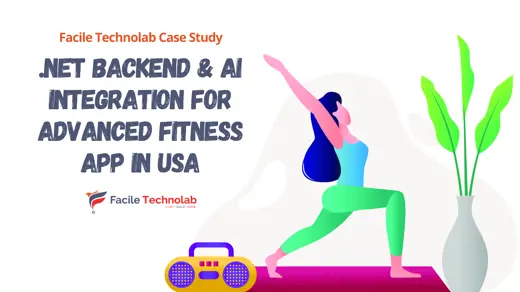
Facile Technolab improved a fitness app with .NET backend fixes, TensorFlow AI integration, and admin panel enhancements for on-time release.
Read Full Case Study
Helped Portugal based startup resolved their tech challenges and release platform.
Read Full Case Study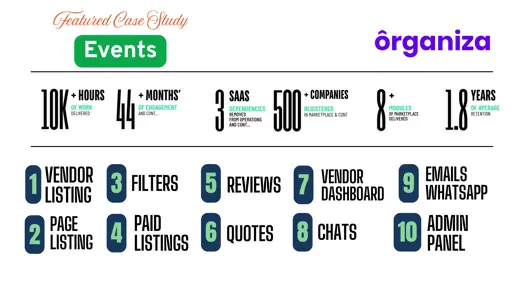
Dedicated team to build an online marketplace platform for events industry client.
Read Full Case StudyAccelerate your business growth with our client-centric software development services.
Your custom software already supports important business processes. What if it could also analyze data, automate repetitive tasks, and help users make better decisions? Our custom AI development services help businesses introduce practical AI capabilities into existing applications without rebuilding everything from scratch.
Enterprise applications hold valuable business data, workflows, and operational knowledge. Our enterprise AI integration services help you connect AI models with existing applications, APIs, and databases to automate processes, improve information access, and support business decisions while preserving established systems.
Adding AI to a SaaS product involves more than connecting to a language model. You need to consider user workflows, data access, response quality, and operating costs. Our AI application development services help SaaS companies build intelligent search, document processing, recommendations, and automation features that fit their existing products
Upgrading outdated frameworks and infrastructure is an important part of modernization, but it can also create opportunities to introduce new capabilities. Our AI integration for legacy applications helps businesses add intelligent search, document processing, predictive insights, and workflow automation to modernized systems without unnecessarily replacing established business logic.
Healthcare applications manage complex workflows, sensitive information, and large volumes of operational data. Our healthcare AI development services help software providers explore AI-assisted document processing, information retrieval, administrative automation, and data analysis while considering privacy, access controls, and existing application requirements.
Manufacturing businesses generate valuable data through production planning, job tracking, inventory, quality checks, and equipment operations. Our AI development for manufacturing software helps businesses explore predictive insights, document processing, production data analysis, and workflow automation by integrating AI with their existing manufacturing applications.
Frequently Asked Questions about Artificial Intelligence Implementation Services
We offer a wide range of AI solutions, including AI-powered automation, predictive analytics, chatbot development, AI-driven marketing, computer vision solutions, and custom machine learning model development. We tailor our services to meet your specific business needs.
We prioritize data security and confidentiality. We use industry-standard security protocols and best practices to protect your data throughout the entire AI implementation process. We also adhere to strict privacy policies.
A single, well-defined AI feature typically ships in 4–8 weeks across two-week sprints. Multi-feature builds or full agent systems take longer and get a specific timeline after the Architectural AI Audit
We provide AI implementation services to a wide range of industries, including healthcare, finance, retail, manufacturing, logistics, education, and real estate. We have experience working with businesses of all sizes and across various sectors.
Yes, we provide comprehensive training to your team to ensure they can effectively use and manage the AI solutions we implement. We also offer ongoing support and maintenance to address any questions or concerns.
Most single-feature AI integrations run in the range of our standard staff augmentation or fixed-scope engagements ($15–$40/hr, or fixed price for defined scope). Larger, multi-model builds cost more and get a specific quote after the Architectural Audit.
AI development (this page) adds a specific capability to your application, a predictive model, a chatbot, document extraction. An AI agent plans and acts across multiple steps with less human steering. See the comparison above, or the Microsoft Agent Framework page if that's closer to what you need.
Yes, RAG is our default approach for document Q&A and knowledge-base features, since it lets you keep your own data under your control rather than fine-tuning a model on it.
Look for experience developing software that works with your existing applications and data, not just AI demonstrations. A suitable AI development company should be able to assess technical feasibility, explain model and integration choices, evaluate output quality, address security requirements, and support the solution after deployment.
Yes. Many AI features can be integrated into existing applications through APIs, backend services, and controlled access to business data. For example, AI can support document processing, intelligent search, predictive analytics, or workflow automation inside a .NET application without requiring a complete rebuild.
The decision depends on the problem, available data, accuracy requirements, cost, and operational constraints. Existing models are often suitable for language-based tasks and can be extended with retrieval-augmented generation. Custom machine learning models may be appropriate for specialized prediction, classification, or anomaly detection. A feasibility assessment helps determine the right approach.
Production AI applications require ongoing monitoring of response quality, reliability, usage, and operating costs. Changes in business data, user behavior, or underlying AI models may also require updates. Maintenance requirements should be defined during the project rather than treated as an afterthought.
If your organization already uses .NET and Azure and you are exploring AI, we can help you move from ideas to production features. Whether you are in Manufacturing, Healthcare, Financial Services & Insurance, or Event Management, we will design and build AI capabilities that fit your existing systems and deliver measurable outcomes.
Connect with us