A practical guide to designing a secure, scalable multi-tenant SaaS architecture on Microsoft Azure, covering tenancy models, data isolation, Azure services, and real-world architectural considerations.
Designing a scalable, secure SaaS product on Microsoft Azure is not just a cloud deployment exerciseit is a long-term architectural decision that shapes how your business grows, how customers trust your platform, and how efficiently your teams operate. A well-executed multi-tenant SaaS architecture allows one application to serve many customers while keeping their data isolated, workloads predictable, and operational costs under control.
On the Windows Azure platformnow commonly called MS Azure, this involves thoughtful system design, careful service selection, and automation across the entire lifecycle of tenant onboarding, monitoring, and compliance. This article explains how experienced teams design production-grade Azure SaaS architecture, highlighting real trade-offs, service choices, and patterns that matter in enterprise and SMB environments alike.
Multi-tenant SaaS means multiple customers share one platform with strong logical or physical isolation.
Azure supports several tenancy models, from fully shared to dedicated environments.
Data isolation, identity, automation, and monitoring are critical parts of the architecture.
Hybrid designs are common in enterprise SaaS development.
Azure managed services and infrastructure-as-code keep operations sustainable.
A multi-tenant SaaS architecture is a software design where one deployed application serves multiple organizationscalled tenants, while keeping each tenant’s data, configuration, and user access separated. Instead of running separate systems for every customer, teams share compute, networking, and storage layers where possible to reduce cost and operational complexity.
In a typical Azure cloud service environment, this includes:
Shared API layers or container clusters
Centralized identity and authentication
Data isolation through schemas or databases
Automated provisioning pipelines
Policy-driven security and compliance
From the perspective of a cloud architect, the hardest part is not provisioning servers; it is ensuring that isolation, scalability, and governance work together across dozens or hundreds of customers while still supporting rapid product developement.
The startup becomes part of the top 10 most promising start-ups recognized by the Australian government as part of their government funding program.
Microsoft’s ecosystem offers a wide range of Azure services that map naturally to SaaS requirements:
Compute: App Service, Azure Kubernetes Service, Azure Container Apps
Data: Azure SQL, Cosmos DB, PostgreSQL Flexible Server
Identity: Microsoft Entra ID, B2C tenants
Networking: VNets, Private Endpoints, Front Door, Application Gateway
Operations: Azure Monitor, Application Insights
Automation: ARM, Bicep, Terraform, GitHub Actions
These Azure managed services reduce the need to operate low-level infrastructure and let teams focus on application logic and customer value.
Strong SaaS systems start with architectural discipline rather than service sprawl.
Isolation defines how safely tenants coexist.
Options include:
Data isolation: Separate schemas, databases, or storage accounts
Compute isolation: Dedicated nodes or clusters for premium customers
Network isolation: VNets and private endpoints
Identity isolation: Directory boundaries and role segmentation
Higher isolation usually improves compliance but increases cost and operational overhead.
Tenants rarely grow at the same pace. Some run monthly jobs; others generate unpredictable spikes.
Design for:
Horizontal scaling of stateless services
Auto-scaling rules
Per-tenant quotas
Tier-based plans
Manual processes do not scale in SaaS.
Tenant onboarding, upgrades, and offboarding should be driven by:
Infrastructure-as-code
CI/CD pipelines
Scripted provisioning
Policy-based governance
Operations teams must answer questions such as:
Which tenant is consuming the most resources?
Who triggered last night’s spike?
Which customer is experiencing latency?
Logs, traces, and metrics should always carry tenant identifiers.
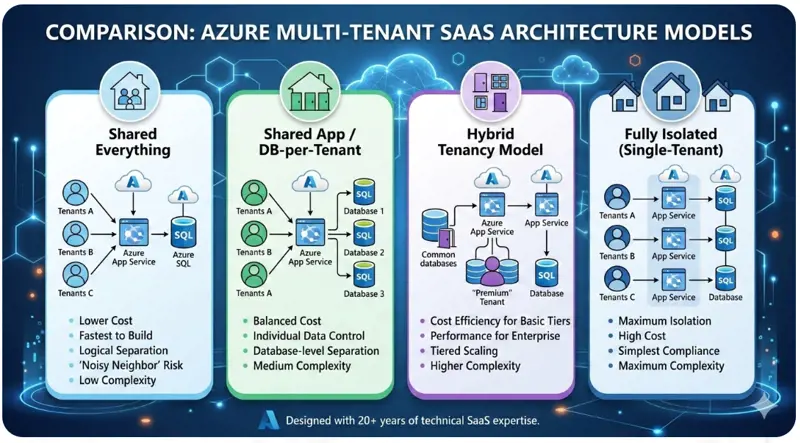
No single model fits every SaaS business. The right approach depends on regulation, customer profile, and revenue strategy.
All tenants share:
Application instances
Databases
Storage
Separation is logical, enforced by tenant IDs and access controls.
Pros
Lowest operational cost
Simple deployment model
Rapid scaling
Cons
Harder regulatory compliance
Noisy-neighbor risks
Complex data extraction
This works well for startups and SMB-focused platforms.
Each tenant receives its own database in Azure SQL or Cosmos DB.
Pros
Stronger isolation
Easier per-tenant restores
Compliance-friendly
Cons
Higher base cost
Schema migration complexity
More automation required
This approach is common in regulated industries and enterprise SaaS development programs.
Most customers run in shared resources, while large or regulated tenants move to dedicated databases or clusters.
Hybrid models support:
Tiered pricing
Performance guarantees
Compliance upgrades
They are the most common long-term pattern in mature SaaS platforms.
Host APIs and services in:
App Service
AKS
Azure Container Apps
State should live in Redis, databases, or message queues, not in process memory.
Every request must determine which tenant it belongs to.
Common patterns include:
Tenant subdomains
JWT claims
Custom headers
Tenant-specific login portals
The resolved tenant context flows through every downstream call.
Tenants differ in:
Enabled modules
Usage limits
Branding
Integrations
Centralize this information using Azure App Configuration or Cosmos DB.
Data is where SaaS platforms most often fail audits.
In shared databases:
Include TenantId columns everywhere
Use row-level security in Azure SQL
Enforce tenant filters in ORM layers
Azure services support:
Transparent Data Encryption
Customer-managed keys
Private endpoints
Policy enforcement
These are essential for financial, healthcare, and government workloads.
Design for:
Per-tenant restore operations
Legal retention policies
Data export during offboarding
These capabilities should be automated & not handled manually during incidents.
Identity complexity increases quickly in SaaS.
Azure supports:
Enterprise federation
B2B collaboration
Consumer identity flows
Multi-directory scenarios
Implement role-based access at two layers:
Platform roles: Operators, admins, support
Tenant roles: Tenant admins, auditors, users
Claims-based authorization keeps services decoupled from directory structure.
A production Azure SaaS architecture typically includes:
Azure Front Door
Application Gateway with WAF
VNets and subnet segmentation
Private endpoints to data services
Network security groups
Security posture should emphasize:
Zero-trust principles
Managed identities
Key Vault for secrets
Continuous vulnerability scanning
Running SaaS at scale is an operational challenge.
Track:
CPU and memory by tenant
Database throughput
API latency
Authentication errors
Tenant-level telemetry is essential for support and billing.
Azure’s tooling allows teams to:
Attribute spend to tenants
Enforce budgets
Forecast growth
Consistent tagging across Azure services is critical for chargeback models.
Infrastructure should be reproducible across environments.
Use:
Terraform or Bicep templates
GitHub Actions or Azure DevOps
Blue-green deployments
Automated tenant bootstrap workflows
Organizations that formalize these patterns often treat them as part of broader Azure-based SaaS development initiatives, aligning engineering decisions with commercial strategy and long-term product roadmaps.
Imagine a B2B analytics platform for logistics companies.
The team launched with:
Shared App Service
A single Azure SQL database
Tenant ID columns in every table
Two years later, enterprise customers required stronger compliance and guaranteed performance. Instead of redesigning everything, the architects:
Provisioned dedicated databases
Isolated tenants into separate VNets
Automated provisioning scripts
Introduced premium tiers
Because tenant awareness was built into the original architecture, the migration was incremental rather than disruptive
| Tenancy Model | Description | Data Isolation Level | Operational Complexity | Cost Efficiency | Scalability | Compliance Readiness | Best Fit For |
|---|---|---|---|---|---|---|---|
| Shared Everything | All tenants share application services and databases with logical separation using tenant identifiers. | Low–Medium | Low | High | High | Limited | Startups, SMB SaaS products, early-stage platforms |
| Shared App + Database per Tenant | Application layer is shared while each tenant has a dedicated database or data container. | Medium–High | Medium | Medium | High | Strong | B2B SaaS platforms, regulated industries |
| Hybrid Tenancy Model | Most tenants use shared resources, while selected tenants are deployed in dedicated environments. | Configurable | Medium–High | Balanced | Very High | Very Strong | Mature SaaS platforms, tiered enterprise offerings |
| Fully Isolated (Single-Tenant) | Each tenant has a dedicated application stack, network, and data layer. | Very High | High | Low | Medium | Excellent | Highly regulated sectors, premium enterprises |
| Shard-Based Multi-Tenant | Tenants are distributed across multiple shared clusters or databases for scale. | Medium | Medium | High | Very High | Moderate | Large-scale SaaS platforms |
Locking into a single tenancy model
Hard-coding tenant rules across services
Ignoring tenant-level telemetry
Manual onboarding
Treating security as an afterthought
Underestimating identity complexity
These mistakes typically surface only after growth accelerates, when change becomes expensive.
Designing a multi-tenant SaaS platform on Microsoft Azure requires more than selecting compute services or databases. It demands disciplined architecture, automation-driven operations, and early planning for isolation, compliance, and scale.
Teams that approach SaaS with a long-term mindset, embracing hybrid tenancy models, tenant-aware telemetry, and the full ecosystem of Azure cloud service offers, build platforms that adapt as customers grow and regulations evolve. For founders, CTOs, and developers alike, this architectural maturity becomes a strategic advantage rather than a technical afterthought.